The Family Health Agent: Product Architecture and Capabilities
A health-continuity agent for a three-generation household: a seven-layer product architecture, four role modes, five business loops, and a three-tier model fallback — with an architecture diagram, three core flow diagrams, and honestly labeled rollout status for every capability.

This article is the product description of the health-management agent inside the family steward “Xiaoguanjia”: what it looks like (architecture), what it can do (capabilities), and what lines it will not cross (red lines). For the design reasoning behind it, see the companion piece, Building a Family Health Service: From a Household Scenario to System Design.
1. Product Positioning
In one sentence: an agent that provides “health continuity” for a three-generation household — it does not practice medicine. It takes charge of the family’s health records, medication and follow-up affairs, visit support, and record-aware health Q&A, so that no medical visit ever has to start from zero.
Who it serves, and what each of them actually needs
| Member | Core need | The product’s answer |
|---|---|---|
| Elders | Chronic care that never drops, no medication mistakes, no missed follow-ups | Medication-list reconciliation, ledger due-date reminders, emergency card |
| Adults (the manager) | One ledger for the whole family; walk into a hospital able to explain everything | One record per person, trend comparisons, one-page visit brief |
| Teenagers | Minimal disturbance, privacy with boundaries | Only risk-relevant items collected; permissions isolated per member |
| The whole family | Ask a question out loud, get an answer with a basis | On-duty answerer with record context + evidence anchoring from a medical model |
What the product is not: it is not online diagnosis (no diagnosing, no prescribing, no medication adjustments), not a checkup provider, and not an emergency-response system (for red-flag symptoms it does exactly one thing: urge you to seek emergency care and hand you the emergency card).
2. Product Architecture
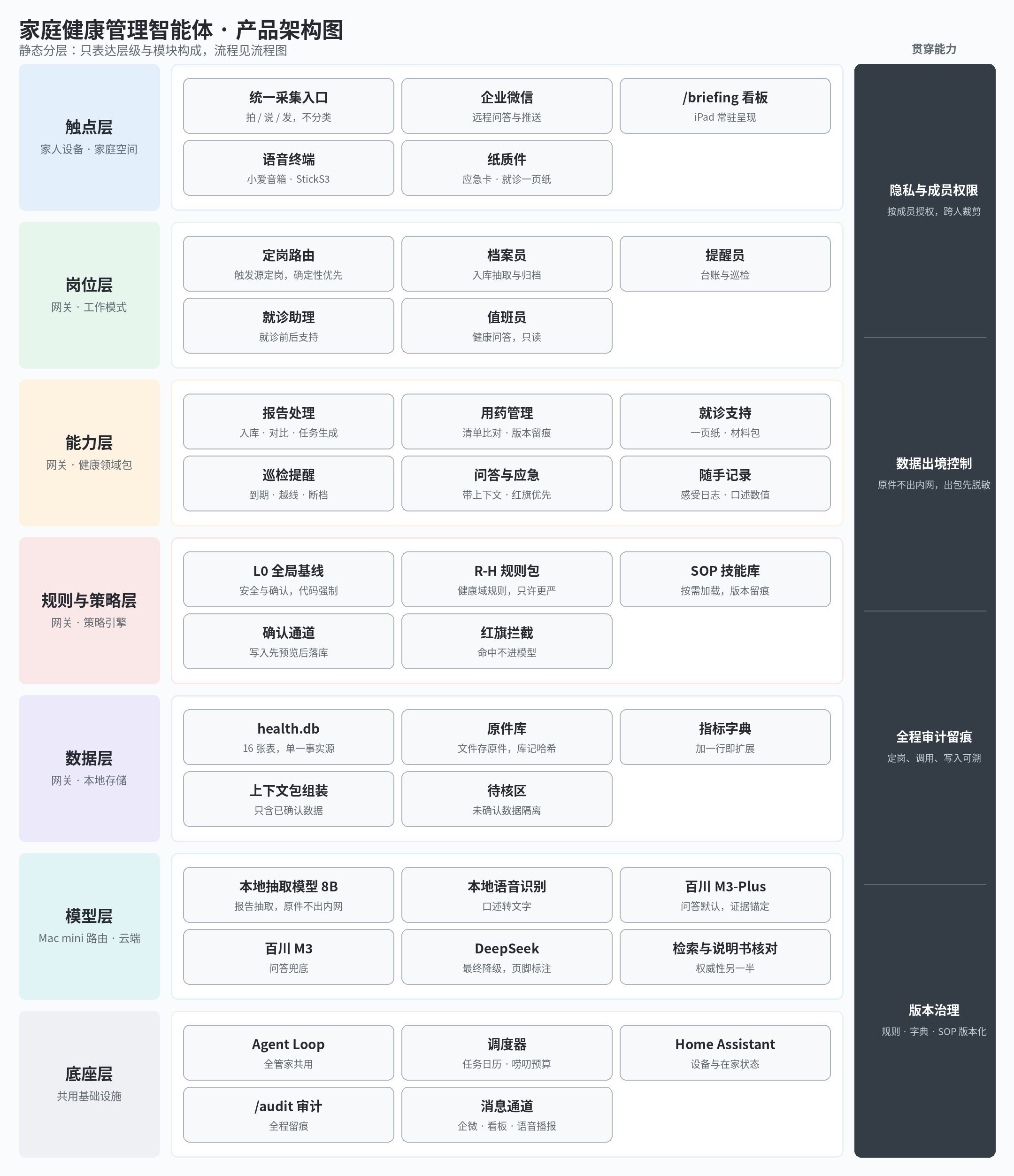
How to read it: seven layers, top to bottom — what the family touches is at the top; the closer to the bottom, the closer to infrastructure. The vertical column on the right holds cross-cutting capabilities that span every layer and belong to none. The health agent is a domain pack inside Xiaoguanjia: the foundation layer is shared with the whole steward, while the six layers above it are health-specific.
Layer by layer
| Layer | Responsibility | Key components and design points |
|---|---|---|
| Touchpoint layer | Every surface where the family meets the system | A single unified intake (snap a photo / say it / send it — no categorizing required); clearly divided presentation duties: the board is for looking, voice is for speaking, WeCom is for remote; the paper emergency card stays — when power and network are down, it is the most reliable surface of all |
| Role layer | Organizing “one agent” into governable work modes | The four roles are configuration packs (prompt fragment + tool allowlist + SOP), not four agents; assignment is primarily deterministic routing (the trigger source decides), and when it is uncertain, the task falls to the read-only on-duty answerer |
| Capability layer | The product capabilities the family can actually feel | Six capability groups correspond to five loops plus casual logging (see Part 3); each group can only invoke tools on its own role’s allowlist |
| Rules & policy layer | Safety boundaries as code | Three tiers of rules (L0 baseline / R-H domain pack / SOPs) converge and are enforced here; the confirmation channel and red-flag interception are engine-level actions that do not depend on the model’s good behavior |
| Data layer | The single source of truth | health.db with 16 tables; originals and structured facts are kept apart (files hold the originals, the database records their hashes); context packs are assembled here — confirmed data only, every item carrying its date and source; unconfirmed data is quarantined in the pending-review zone and may not be cited downstream |
| Model layer | A model lineup divided by task | Extraction and Q&A are chosen separately: extraction uses a local 8B model (originals never leave the home network); Q&A uses Baichuan M3-Plus (evidence anchoring), M3 as fallback, and DeepSeek as the final downgrade; models are wired in through aliases on the mini router, so swapping a model changes nothing above this layer |
| Foundation layer | Infrastructure shared with the whole steward | Agent Loop, scheduler (including the health domain’s own nagging budget), Home Assistant, /audit, message channels — health does not rebuild its own foundation |
| Cross-cutting capabilities | Spanning all layers | Per-member privacy authorization, data-egress control, end-to-end audit, and version governance for rules, dictionaries, and SOPs |
3. Product Capabilities
Listed by capability domain. Each item states how the family experiences it, and its status (Live / Integrated, spot-check pending / Planned).
3.1 Records and data capabilities
| Capability | Description | Status |
|---|---|---|
| One record per person | Eight modules: baseline card, risk list, checkup series, metric trends, visit history, medication list, three ledgers, special topics | Live |
| Metric trends | One row per metric, reference ranges stored alongside each value (ranges differ by institution and are never forcibly unified); years link up into trends automatically | Live |
| Baseline backfill | Allergies / past conditions / family history / current medications are filled in through interviews; anything missing is listed as missing, never inferred or fabricated | Live (interviews to be held member by member) |
| Fact versioning | Corrections supersede old rows with new ones (supersedes), so history stays traceable; raw extraction output is retained in full, so the archive can be re-extracted from stock as models improve | Live |
| Member permissions | Viewing and receiving are authorized per member; unconfirmed data is quarantined globally | Live (permission table is a conservative default, to be confirmed member by member) |
3.2 Report processing capabilities (archivist)
| Capability | Description | Status |
|---|---|---|
| Unified-intake classification | Anything arrives via photo / voice / message on any channel; the system classifies first, then routes (reports / prescriptions / invoices / certificates / anything unclear goes to the pending-review zone) | Live |
| Local extraction | A local 8B model on the Mac mini extracts section by section against the metric dictionary; originals never leave the home network | Live |
| Value cross-check | Every extracted value is compared against the source text by code; mismatches are flagged red for human review — nothing slips into the archive unchecked | Live |
| Preview-and-confirm ingest | Record draft + trend comparison + follow-up items + missing-information list; data is written only after a family member confirms | Live, pilot tested |
| Recommendations become tasks | Every item in a report’s “conclusions and recommendations” is converted into a follow-up or screening task in the ledger | Live |
3.3 Medication management capabilities (archivist / reminder)
| Capability | Description | Status |
|---|---|---|
| Versioned medication list | Current and historical medications in one table with validity management; stopped medications keep their reason — nothing is overwritten or deleted | Live |
| New-prescription diff | A photo of a new prescription or medicine box is diffed against the current list to show additions and removals; previewed first, effective only after confirmation | Live |
| Suspected-interaction alerts | The only permitted wording is “please confirm with the prescribing doctor or a pharmacist” — no elaborated assertions (R-H03) | Live, pending real-world validation |
| Medicine-cabinet patrol | A weekly scan of stock levels and expiries (the same mechanism as the household’s food-expiry tracking) | Live |
3.4 Visit support capabilities (visit assistant)
| Capability | Description | Status |
|---|---|---|
| One-page visit brief | Auto-assembled before a visit: symptom timeline (including the symptom threads strung together from body-feel logs), recent metric trends, medication list, and questions to ask | Live |
| Emergency card | Allergies, underlying conditions, long-term medications, emergency contacts; the electronic version is retrievable in seconds, and a paper copy goes on the fridge | Live |
| Pre-examination preparation | Staged preparation reminders for gastroscopy and similar exams (items such as fasting and pausing medication that require a doctor’s confirmation are flagged separately) | Designed, SOP to be written |
| Discharge / post-operative follow-up | Follow-up dates and care notes are extracted from the discharge summary and turned into a follow-up task line | Designed, SOP to be written |
| Material-pack assembly | Commercial-insurance claim packs and referral packs are gathered and exported automatically by encounter | Designed, Not enabled |
3.5 Patrol and reminder capabilities (reminder)
| Capability | Description | Status |
|---|---|---|
| Three ledgers | Follow-ups / screenings / vaccinations share one tasks table distinguished by type, with automatic due-date scanning | Live |
| Trend patrol | Drift is judged against each person’s own baseline (not only population reference values); anomalies go into the monthly brief | Live |
| Gap detection | “Due for a test but not tested” and “due for a follow-up but not followed up” are themselves signals the patrol picks up | Live |
| Restraint mechanism | A health-specific nagging budget + quiet hours; routine items go to the board or the weekly digest only, and only urgent items are pushed directly | Live (budget values are draft values, calibrated in practice) |
| Monthly family health brief | A monthly digest for the whole family: new additions, trend changes, open items, and next month’s schedule | Designed, awaiting activation |
3.6 Q&A and emergency capabilities (on-duty answerer)
| Capability | Description | Status |
|---|---|---|
| Context-aware Q&A | When a question points to a specific member, code assembles a de-identified context pack (confirmed data only, each item with date and source); general questions carry no personal data | Integrated |
| Dedicated medical model | Baichuan M3-Plus by default (evidence anchoring), M3 as fallback, DeepSeek as the final downgrade — with the footer honestly naming the model that actually answered | Integrated, spot-check pending |
| Evidence presentation | Answers carry citation anchors and record sources; when the record has nothing, the answer says so plainly instead of dressing general knowledge up as record fact | Integrated (the source-list field behind the anchors is still to be verified) |
| Red-flag interception | Red-flag words such as chest pain are intercepted by code before any model call: emergency guidance + the emergency card, zero model invocations | Live, pending real-world validation |
| Remote downgrade | Remote channels such as WeCom automatically use a downgraded tool set; spending and identity actions can never be executed remotely | Live |
| Casual logging | Dictated body-feel notes are archived verbatim, without interpretation; dictated values such as blood pressure go straight into observations | Live |
3.7 Continuous collection capabilities (Planned)
| Capability | Description | Status |
|---|---|---|
| Automatic blood-pressure logging | An Omron Bluetooth monitor read locally through Home Assistant, or the Withings API cloud route (one of the two; undecided) | Selection research done, not purchased |
| Watch data back-flow | A phone bridge: Health Auto Export on iOS, Health Connect + Gadgetbridge on Android; data lands in the pending-review zone before being written | Route verified, not developed |
| Episodic CGM | A Libre sensor worn for 14 days per round via the LibreLinkUp community channel; used for dietary-response assessment, then archived | Route verified, Not enabled |
| Three-tier assessment | Instant threshold breach (doctor-set trigger lines) / drift from personal baseline / gap signals; consumer-grade data is graded and used for trends only | Rules designed, ships with data collection |
4. Core Flows
4.1 Report ingest flow
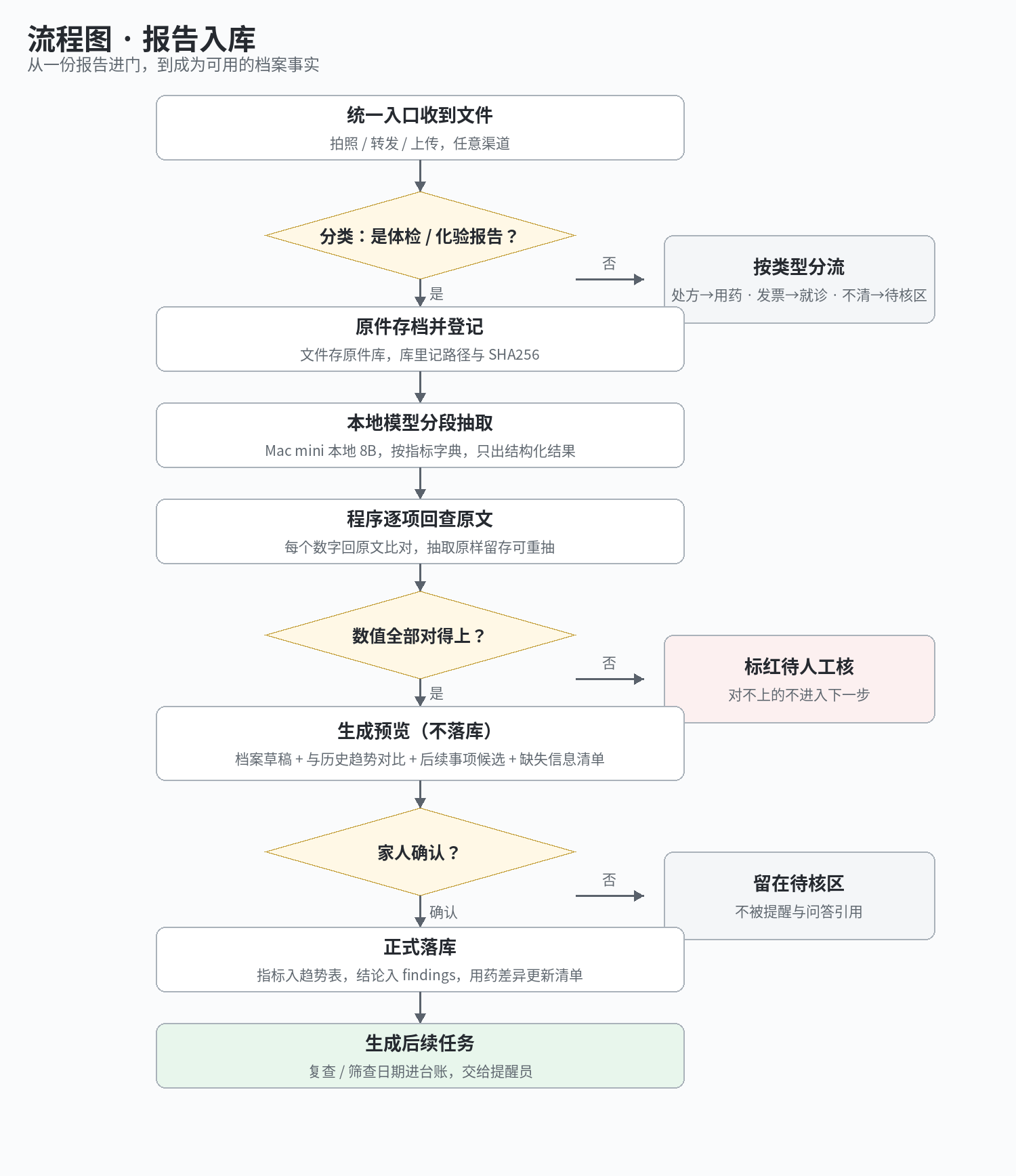
Key points: this chain has three quality gates — a programmatic cross-check after extraction (do not trust the model’s eyes), family confirmation before anything is written (do not trust the system’s judgment), and quarantine of unconfirmed data (do not let half-finished data contaminate reminders and Q&A). Originals and raw extraction output are retained permanently, so re-extraction and audit remain possible in the future.
4.2 Health Q&A flow
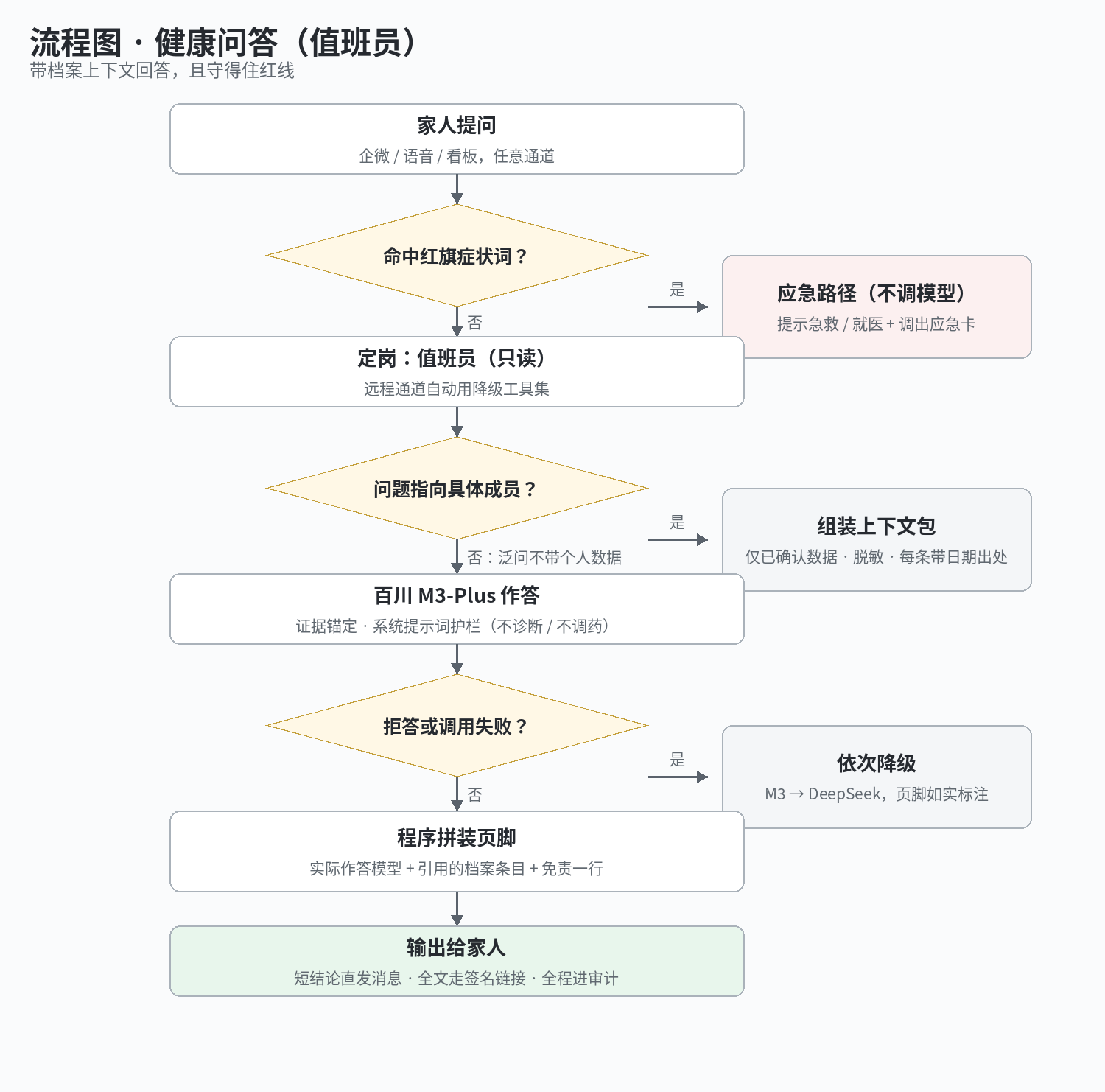
Key points: red-flag judgment happens before the model (a code-level wordlist interception); the context pack is assembled by code, not fetched by the model itself (the model never sees what it should not see); the fallback chain guarantees availability, and the footer is assembled by code — which model answered and which record items were cited are always visible to the family, and the model may not rewrite them.
4.3 Patrol and reminder flow
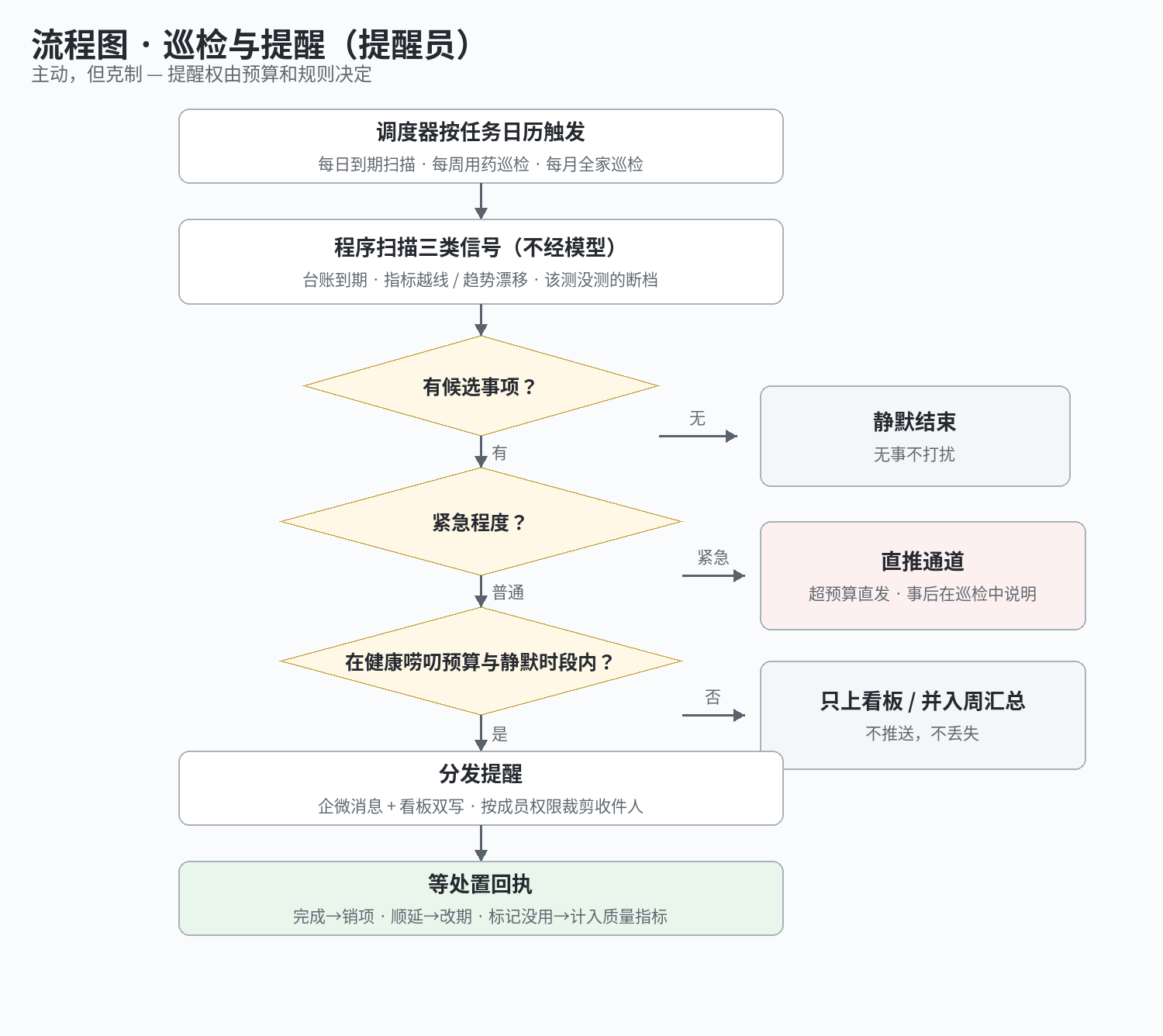
Key points: candidate items are produced by programmatic scanning (due dates, threshold breaches, and gaps are all deterministic judgments that never pass through a model); whether anything is sent is decided by the budget and the rules, not by the model; when there is nothing, the system stays silent — the ceiling on proactiveness is defined by the restraint mechanism, and that is the fundamental difference between a health product and marketing push notifications.
5. Capability Boundaries and Design Principles
Hard boundaries (no model and no role may cross them)
- No diagnosis, no prescribing, no advising anyone to stop or change medication, and no self-invented screening items or trigger lines (trigger lines come only from a doctor or the responsible person’s approval)
- Every health write is previewed first and written only after human confirmation; unconfirmed data may not be cited by reminders or Q&A
- Originals and raw trace text never leave the home network; cloud Q&A receives only de-identified context packs
- For red-flag symptoms, the first action is always guidance to seek care — never answering the question
Design principles (in product terms)
- Judgment belongs to code, language belongs to the model — due dates, threshold breaches, and trends are deterministic computations; the model only extracts, understands, and expresses.
- Red lines rest on mechanisms, not on good behavior — prohibitions live at the tool layer and the policy layer: with no corresponding tool, the model cannot do it even if it wanted to.
- Evidence over fluency — the decisive criterion in Q&A model selection is verifiable evidence anchoring, not eloquence.
- Restraint is a feature — the nagging budget, not interpreting casual logs, and not disturbing when there is nothing to say are all deliberately designed product behaviors.
- Leave structure for change — metrics extend through the dictionary, models swap through router aliases, roles are added or removed as configuration packs, rules are governed by versioning; the system is built on the assumption that it will change.
- Assume single points will fail — the three-tier model fallback, dual-channel delivery (board + push), and the paper emergency card are all advance answers to “what happens when it breaks?”
6. Status and Evolution
| Phase | Contents | Status |
|---|---|---|
| Phase 1 (complete) | Records and database, the four roles and the rules system, report ingest, patrol reminders, on-duty Q&A (Baichuan integrated) | Live |
| Phase 1 acceptance (in progress) | Charter rules validated item by item in practice; Baichuan side-by-side spot-checks (including trap questions); SOP-01 through SOP-10 written into files one by one | In progress |
| Phase 2 (not started) | Household-wide rollout: baseline interviews, bulk import of past years’ reports, member-by-member permission confirmation | Not started |
| Phase 3 (designed) | Hardware continuous collection: get one blood-pressure chain working end to end as the template, then replicate; watch bridges and CGM connected per member | Not started |