The Family Steward, Reviewed in Full: From Value Discovery to Commercialization
A complete retrospective of a self-built family steward: why it was built, who it serves, how the system is layered, what genuinely works, which attempts hit walls, and how a personal project could become a product — standardization, data security, and four revenue lines.
This is a full retrospective of the family steward (“Xiaoguanjia”) I built for my own home: from an October 2026 experiment replicating an AI gadget, through the home gateway, the terminal matrix, a phone actuator, a WeCom channel, and a model-layer rebuild. Status discipline is strict throughout: only capabilities backed by real-device or real-API test evidence count as done; passing an API probe test does not count as an implemented feature.
1. Value Discovery: Why Build This
1.1 The starting point
This did not begin as a commercial project but as a verification impulse. Muse Gadget demonstrated one shape of “AI with a body” — a desktop terminal with a screen and a microphone, able to listen and speak, backed by intelligence that can actually get things done. That raised the core question this whole project answers: can Muse-class conversation and execution be brought into a real home, to run real devices and real household affairs?
1.2 The real pain points of the smart home
- Fragmentation. Devices are scattered across Mi Home, Home Assistant, and vendor apps; cross-ecosystem automation is manual. The more devices a home has, the higher the control cost — the opposite of the “smart” promise.
- Voice assistants that answer but don’t act. Retail speakers can chat and switch lights, but they hold no context, chain no multi-step tasks, and remember no household preferences. They are remote controls, not stewards.
- Three generations under one roof. Grandparents can’t use apps; children have no phones. Household services need zero-learning-curve entrances (speech, a wall board) and disciplined interruption (quiet hours, a nagging budget).
- Real errands have no APIs. Food delivery, medicine, parcels, medical reports — most high-frequency household errands expose no open interfaces. A pure-API road ends quickly; this is the root of the later phone-actuator and payment-by-proxy designs.
- Privacy and control. Household conversations, voiceprints, and daily routines are the most sensitive data there is. A steward that is fully cloud-based, unauditable, and uninterruptible is inherently untrusted in a home.
1.3 What the steward actually does (scenario portraits)
The steward’s value is not in single commands but in living inside the family’s physical environment and shared life. The scenarios below describe built capabilities or finalized designs:
Caring for the elderly
- Medication and health rhythm: the steward remembers what to take, when, and how many days of supply remain. At the right time the board shows it in large type and the living-room speaker reads it aloud; adult children away from home receive a “taken / unconfirmed” receipt via WeCom, and an unconfirmed dose escalates automatically — the elder never has to touch an app.
- Proactive care: a cold snap triggers a reminder to dress warmly; haze triggers window-closing; night-time trips to the bathroom light a low path automatically; checkup appointments and report expiries are tracked by the steward, not by an elder’s memory.
- Safety net: unusually long inactivity, or gas/water-leak sensor alarms, notify the whole family in parallel over a hard real-time path — no “guessing” involved.
Caring for children
- Rhythm and routine: waking, school, homework, and bedtime are paced by the board and voice, with tone and frequency configured for the child’s age.
- The departure steward: “Rain today — put an umbrella in your bag”; “PE class this afternoon — sports shoes.” Cross-referencing weather × schedule × packing list is a joint judgement no single app makes.
- Screens and content: TV/tablet time is gently enforced by rule, instead of parents shouting every time.
Shared household affairs
- One shared list: anyone who says “we’re almost out of tissues” to the living-room speaker adds it to the same family shopping list. The steward aggregates, reminds, and prepares the order; the final purchase step is always confirmed by a family member.
- One shared schedule: who picks up the child, who takes a parent to a follow-up appointment, whether all three parcels have arrived — the steward keeps a single source of truth for “things the whole family needs to know” and proactively flags conflicts, instead of leaving them scattered across everyone’s heads.
- Cross-generation relay: an elder states a need by voice at home; an adult child receives a payment-by-proxy card away from home and pays personally. The steward connects the generation that can’t use smartphones with the generation that isn’t home, inside a single errand.
Shared memory
- “When was the air-conditioner filter last changed?” “Where is the child’s vaccination booklet?” “Which drug is Dad allergic to?” Household memory is structured and kept (device records, member health essentials, item locations, important dates), answerable on demand, with answers traceable to the records themselves.
How this differs from a family WeChat group (the two are not the same kind of thing)
| Family WeChat group | Family steward | |
|---|---|---|
| Information form | A chat stream; old messages sink and must be dug out | Structured memory and state, searchable and askable at any time |
| Execution | Can only pass messages; nothing gets done by itself | Acts directly (controls devices, looks things up, prepares orders) and reports results |
| Presence | Lives inside a phone; invisible unless opened | Embedded in the physical space: the board is visible at a glance, the speaker answers when asked |
| Initiative | Silent unless someone speaks | Reminds, patrols, and suggests based on schedule and state |
| Memory | No shared memory, only chat logs | A household archive that accumulates and grows more useful |
Physical presence. The board hangs in the living/dining room: today’s schedule, to-dos, weather, and reminders are visible at a glance — no phone, no app to open. Voice entrances are distributed through the rooms, answering whenever asked. This is the fundamental difference between ambient intelligence and phone intelligence, and the reason this product insists on its own terminal matrix (board + speaker + portable screen).
1.4 Target customers (two lines)
- The home line (proof): my own home — three generations, many devices, a technically capable owner and non-technical family. First prove that a real family actually uses it and benefits.
- The commercial line (replication): carrier broadband households, prioritizing families with elders and children. Distribution rides on carrier installation visits and broadband bundling; trust rides on “data stays home + carrier compliance backing.” The smart-home hub proposal written for a provincial carrier follows this line (see Section 6).
1.5 Intended effect (product definition)
In one sentence: a family steward that is predictable, interruptible, and always on call — not a robot that runs off on its own. Four acceptance criteria, all later written into architectural red lines:
- One entrance runs the home: devices, memory, schedule, and errand lookups in a single sentence wherever possible;
- Graded action: low-risk matters are handled automatically; the final submission involving money or real identity is always human-confirmed;
- Fully auditable: every decision and action leaves a complete trace the family can inspect and correct — and corrections become rules;
- Data stays home: passwords, voiceprints, and raw traces live only on the LAN; the cloud gets only what it should.
2. Product Framework and System Architecture
2.1 System architecture diagram (layered structure: layers and modules)
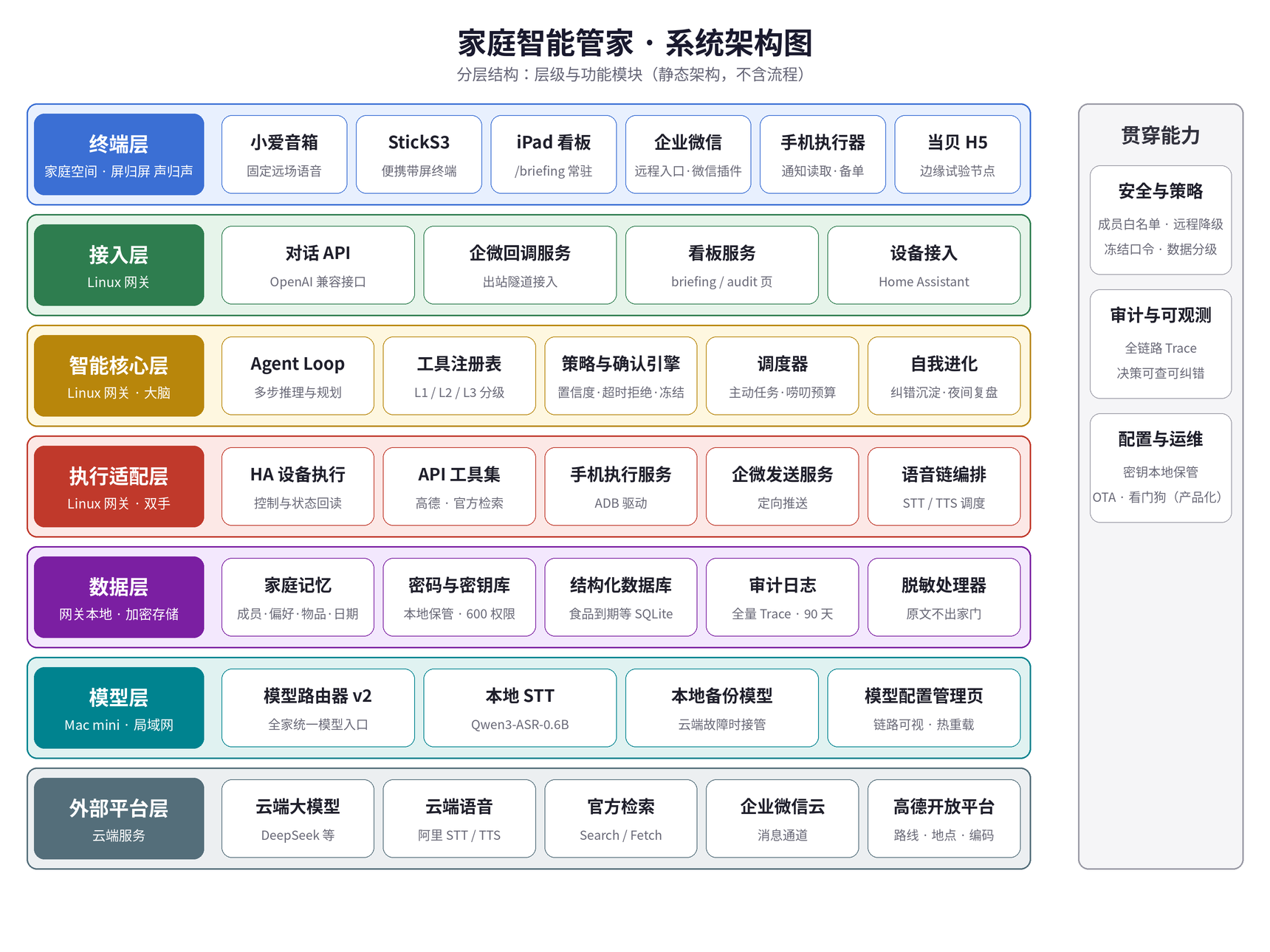
How to read it: seven layers, top to bottom — Terminal, Access, Intelligent Core, Execution Adaptation, Data, Model, External Platform. Each layer’s left block names its deployment carrier; the boxes inside are that layer’s functional modules; the right column holds three cross-cutting capabilities (security & policy, audit & observability, configuration & operations). This diagram expresses static structure and ownership only, not call flow (the core loop is in §2.3).
2.2 Network topology
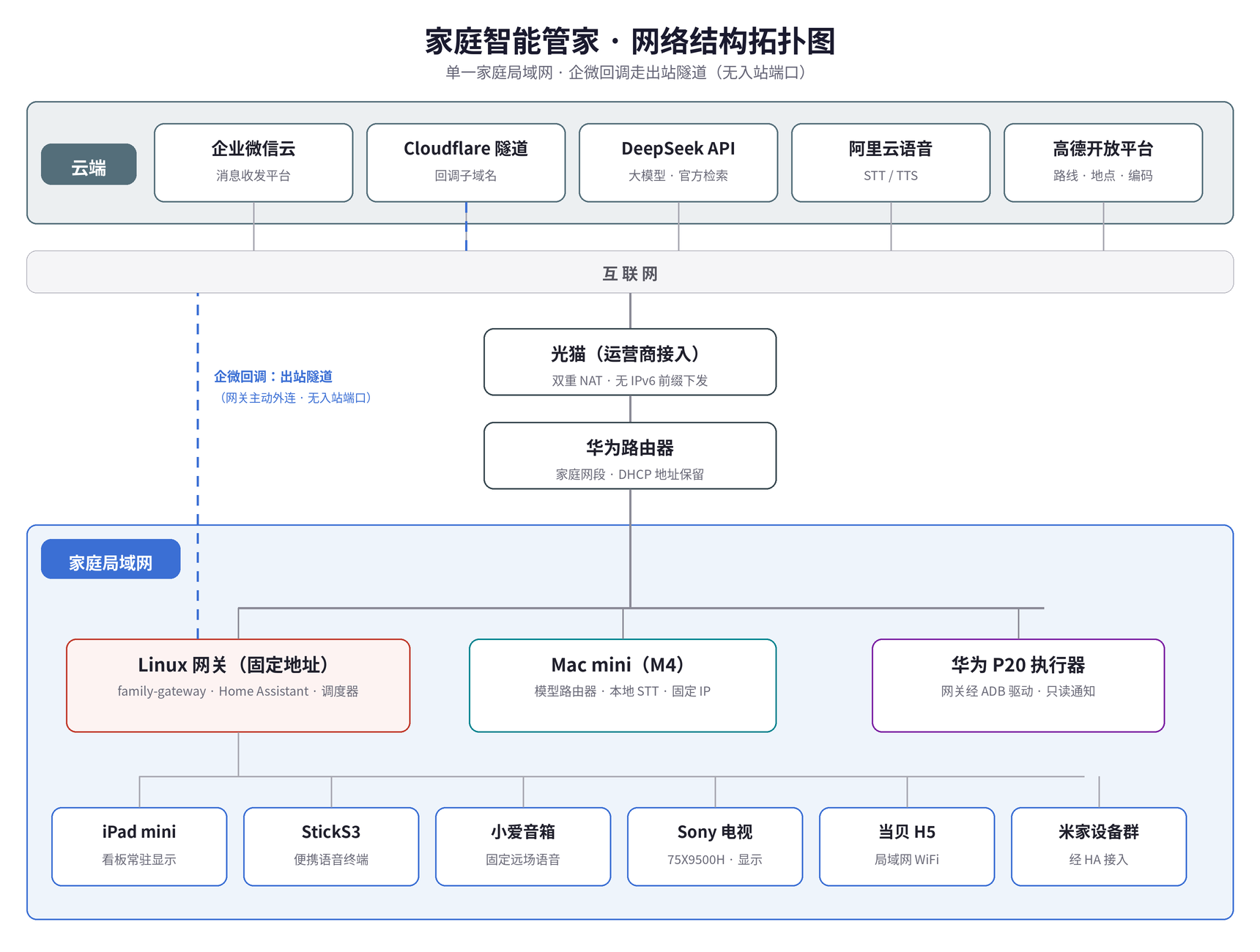
Topology notes: a single home LAN segment; the gateway and the Mac mini are always-on nodes with fixed addresses; the WeCom callback opens no inbound port and runs over an outbound Cloudflare tunnel initiated by the gateway; the phone actuator is driven by the gateway over ADB directly, never via cloud.
2.3 The core loop: input → AI decision → action → check → feedback
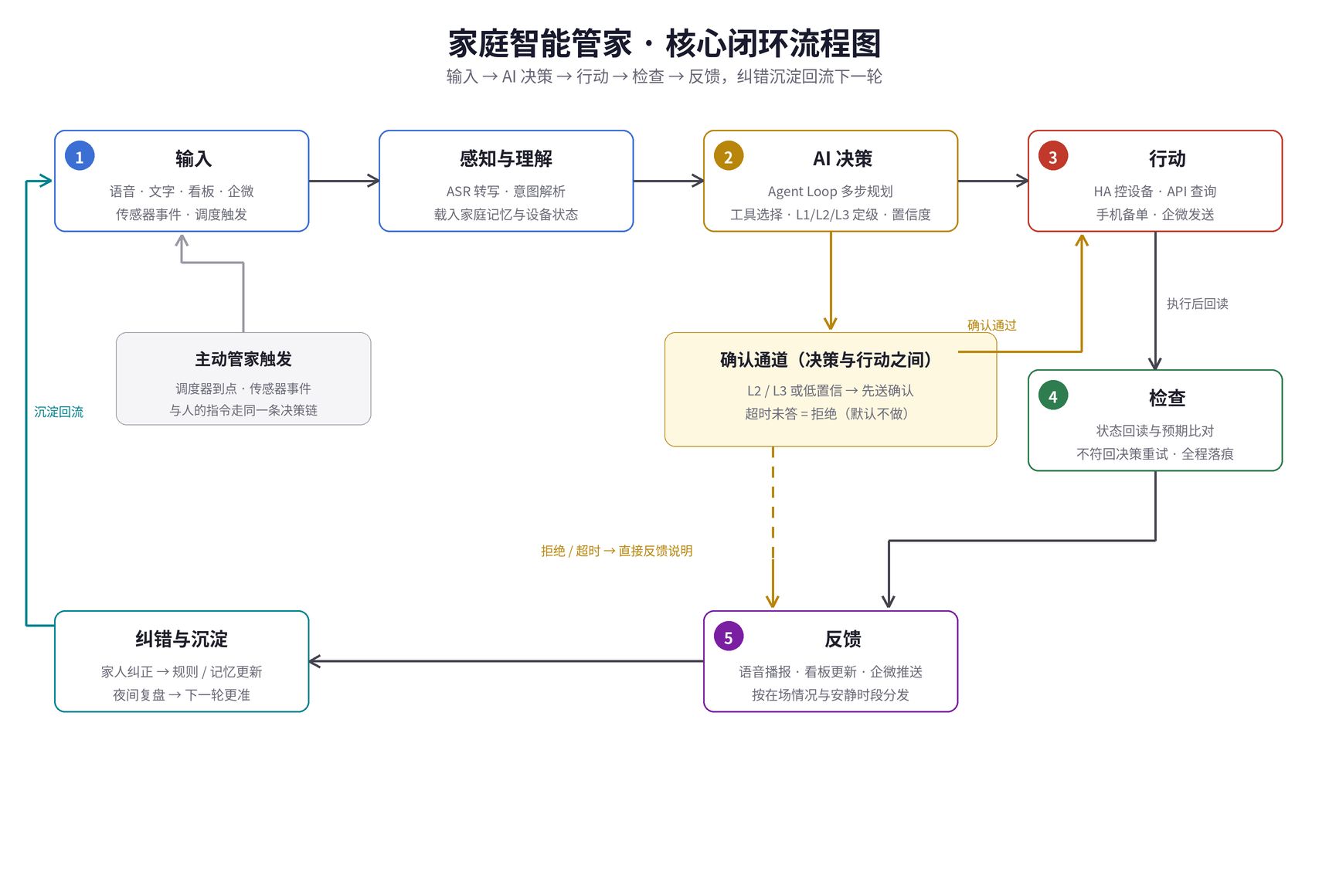
Walking the loop:
- Input is more than people speaking: sensor events and scheduler triggers (medication, patrols) enter the same decision chain as human commands — this is the dividing line between a proactive steward and a voice remote control.
- Decision is made by the Agent Loop: it consults household memory and current device state first, then picks tools; every tool carries a risk grade and a reversibility flag, and every decision must state its confidence.
- Before action there is a confirmation gate: anything involving money, real identity, or low confidence is sent for confirmation first, and a timeout means refusal — the default is not doing it, not doing it and explaining later.
- Check is an independent stage: after execution, device/API state is read back and compared with intent; a mismatch returns to decision for retry or escalation. “Command sent” never counts as “job done.”
- Feedback is distributed by person and occasion (voice when present, WeCom when away, persistent items on the board), and family corrections are distilled into rules and memory so the next round decides better — the last stage of the loop is learning.
2.4 Three key design decisions
- Agent Loop + risk grading, not single-shot command mapping. The steward’s value lies in multi-step tasks and proactive service, which require every step to be gradeable, confirmable, and rollback-able. Two red lines run through the whole project: the final submission for money or real identity is always human-confirmed; the agent has no shell.
- Channel redundancy instead of presence sensing. A design that fused phone Wi-Fi and sensors to infer “is anyone home” was rejected in review — the inference is never reliable. A persistent board plus redundant push channels covers the need more dependably than precise sensing.
- Cloud-edge split: state and intelligence in the cloud, control and autonomy at the edge (the same principle on the commercial line). Locally, only deterministic work happens (rule engine, executors, hard refusals, de-sensitization); raw sensitive data never leaves the box; the cloud sends down only intents, templates, and firmware. This single decision is simultaneously the privacy selling point and the offline-availability guarantee.
2.5 Self-evolution design (approved, partially landed)
Corrections → rules; implicit feedback → autonomy adjustment; a nightly comparative review while the house sleeps; an accumulating episode library. Explicitly no online RL. The direction is “understands this family better over time,” not “acts more autonomously over time.”
3. Household Data Security: Local Encrypted Storage and the Cloud-Edge-Device Split
3.1 Why household data is special
Household data is the most sensitive category of data there is: it simultaneously contains identity (members, voiceprints), behavior (routines, comings and goings, conversations), health (medication, checkups), property (orders, bills), and space (cameras, sensors) — and it concerns minors and elders, the very people least able to manage consent. The conclusion up front: for household data, trust cannot rest on promises (a privacy policy); it can only rest on architecture — making it physically impossible for sensitive data to leave the home is the only verifiable solution.
3.2 Local encrypted storage (what makes the trusted solution)
- Classification decides location (already enforced as rules in this project):
- Never leaves home: passwords and keys, voiceprint features, raw conversations and traces, raw household memory, original medical documents, precise location trails;
- May leave after de-sensitization: device states, event summaries, statistical aggregates (the de-sensitizer runs locally on the gateway; originals and outbound versions are physically separated);
- Inbound only: cloud-issued intents, rule templates, skill packages, and firmware.
- Encryption at rest. The gateway data layer (memory, vault, SQLite, audit) is encrypted on disk; keys exist only locally (file permissions 0600 as a baseline; a secure element/TPM holding the root key at productization). Audit logs are likewise encrypted and append-only, resisting after-the-fact tampering.
- Access and channel control. A per-member allowlist (WeCom authorizes members one by one); remote channels receive a downgraded tool subset (L3 and money/identity actions are never executable remotely); sensitive operations require step-up verification; one freeze phrase can halt the system for the whole family.
- Auditable means trustworthy. Every data access and outbound transfer leaves a trace the family can inspect. “You can check” builds more trust than “we promise not to look” — and it disciplines the vendor too.
- Portable. Household data can be fully exported and fully deleted. Data sovereignty belongs to the family, not the vendor — the fundamental dividing line from platform smart homes.
The limits deserve stating: localization shifts part of the security burden onto the device itself (physical security, firmware updates, disk lifespan), so it must ship together with dual-partition OTA, a watchdog, and encrypted backup — “stored locally” alone is not a solution.
3.3 A sensible cloud-edge-device combination
Neither all-cloud nor all-local is right. The division of labor, calibrated by this project’s measurements:
| Layer | Carries | Does not carry | Evidence |
|---|---|---|---|
| Cloud | LLM inference, ecosystem APIs, device shadows, rule templates, skill distribution, OTA, cross-household de-sensitized aggregation | Raw household data; final execution decisions | Local generation lost to cloud judging in benchmarks (24:17 over 24 cases); ecosystems and scale effects exist only in the cloud |
| Edge (home gateway / hub box) | Agent decisions and policy, tool execution, rule linkage, data custody and de-sensitization, offline autonomy, audit | Large-scale training; cross-household statistics | Control must be low-latency and work offline; data is “locked” at this layer before summaries go up |
| Device (terminals and sensors) | Perception (pickup, vision, sensing), presentation (board, announcements), near-field interaction | Decisions and long-term storage | Pickup quality and screen placement are physical properties that only exist at the device; dumber endpoints are cheaper and more reliable |
Three combination principles:
- Connections are initiated from inside out: the edge connects to the cloud (tunnels/long connections); the home opens no inbound ports (this project’s WeCom callback is implemented exactly this way);
- Degradation has a path: if cloud or network fails, the edge keeps core abilities (device control, rules, reminders) — it becomes dumber, not paralyzed; the gateway also keeps a direct-to-cloud bypass so a model-router failure is never a single point of failure;
- Conclusions travel, in both directions: only de-sensitized states and events go up; only intents and templates come down; raw data crosses the boundary in neither direction.
4. Implementation Review (in Detail)
4.1 Implementation notes by subsystem
(1) The home gateway (family-gateway)
- Form: a FastAPI service on a Linux PC at a fixed LAN address, exposing an OpenAI-compatible conversation endpoint shared by the home terminals, the speaker chain, and the WeCom callback.
- Intelligent core: upgraded from single function calls to an Agent Loop (multi-step reasoning and tool chaining); the tool registry uniformly declares each tool’s risk grade (L1 read-only / L2 reversible write / L3 high-risk), reversibility, and parameter constraints.
- Policy execution: confidence-triple evaluation plus a confirmation channel (board/voice/WeCom delivery, timeout = refusal); a family-wide freeze phrase; messages split into notifications, confirmations, and questions.
- Scheduler: an always-on task system independent of conversation (timed reminders, patrol-type tasks), governed by a nagging budget and quiet hours — proactive service has a ceiling and does not harass.
- Household memory: Markdown files (members, preferences, items, dates) + a separate credential vault (0600) + a food-expiry SQLite database; memory stays human-readable and human-editable, never locked inside a database.
- Audit (completed): full traces land as daily-rotated JSONL (90-day retention, 0600); the /audit page renders the complete decision chain per day — the entry point for accountability and correction.
(2) The model layer (fully completed)
- Model router v2 on a Mac mini (M4): one OpenAI-compatible entrance for the whole house; the judging model runs asynchronously in parallel, adding no latency to the main path; online judging is primary, a local small model is backup, with sampled dual-runs cross-checking each other; the gateway keeps a direct-to-cloud bypass for when the mini is down.
- Local STT: Qwen3-ASR-0.6B resident on the mini (<2.5 GB), cloud STT as fallback, accepted against a character-error-rate gate on 20 real recordings.
- Model configuration admin page: visual maintenance of the model registry and chain ordering on the LAN; keys shown masked to their last four characters; hot reload with automatic rollback to last-good configuration; the gateway keeps an independent emergency direct configuration.
(3) The terminal matrix
- StickS3 (M5Stack, ESP32-S3): full factory-firmware backup, ESP-IDF environment, port of the open Muse SDK, and a flashed firmware with an avatar UI. It is the portable screened terminal (microphone/speaker/buttons/sensors); the brain lives entirely in the gateway.
- The 2017 first-generation Xiaomi speaker: with flashing ruled out, two paths were taken — a Home Assistant text-announcement entry was found and verified, so the speaker can proactively read arbitrary text aloud (the proactive-voice channel works today); full conversational docking follows the zero-flash xiaogpt route, with the gateway offering a streaming compatible endpoint.
- iPad mini board: the /briefing page runs permanently (Safari full-screen, never sleeps), carrying family messages, reminders, notification walls, and confirmation cards. iOS policy confines it to display; voice belongs to the speaker/StickS3.
- WeCom (connected end-to-end): the team and the self-built “Family Steward” app were created; the gateway callback connects outbound via a Cloudflare tunnel, closing the send/receive loop and the trusted-IP configuration; outbound messages can target individual members (textcard and others), and family members can send and receive inside WeChat via the WeChat plugin. Security landed as a sender allowlist, downgraded remote tooling, the freeze switch, and full audit tagging. A JD payment-by-proxy pilot (a phase-2 application on this channel) is designed but not yet implemented.
(4) The Home Assistant execution layer The gateway operates real Mi Home devices through HA (switching, querying, linkage), verified end-to-end; HA also provides device state read-back (the loop’s check stage) and speaker announcement/volume entities.
(5) API tools
- Amap (completed): a Web-service key is integrated into the gateway; route planning, place search, and geocoding tools are live, giving travel questions and reminders real data.
- DeepSeek official search (Search/Fetch): interface and strategy verified and fully specified (reusing the existing key, billed per call); implementation pending dispatch.
- JD Union (not counted as implemented — see 4.4).
4.2 Completed (with test / in-service evidence)
- Gateway text and voice loop: conversation → decision → HA → real Mi Home devices, end-to-end (2026-10-13)
- Agent architecture v1 landed: Loop + graded tools + confirmation channel + scheduler + audit page
- Model layer rebuild fully completed: router v2, local STT, gateway changes, admin page
- Household memory and food-expiry store; /briefing board in permanent service
- WeCom channel connected: callback send/receive, targeted push, WeChat plugin usable
- Amap tools live
- StickS3 terminal firmware and avatar UI; the speaker’s HA proactive-announcement channel
- Phone notification reading: allowlist + parse isolation + board posting, measured at 772 successes / 1 failure
- Commercial-line documents: the provincial-carrier proposal, full and condensed editions, delivered
4.3 Key explorations (touched, tested, judged)
(1) Phone control (a spare Huawei P20 as actuator) Motivation: high-frequency household errands (parcels, food, medicine, e-commerce) have no open APIs, so the steward would borrow a spare phone as its “hands.” The settled design: the gateway drives the phone over ADB as a pure executor — the phone makes no decisions; decision, policy, confirmation, and audit all live in the gateway, and visual understanding is supplied by a cloud phone-vision model (with a local-switch slot reserved). Course and outcome: of read-only phase 1 (notification reading + information queries), notification reading runs stably (772/1); query scenarios hit platform security verification and page-guard conflicts (JD price sorting vs. the page-boundary guard) and never passed acceptance. Development paused on 2026-11-02 and resumed alongside the WeCom line on 11-03; the owner’s own verdict is that phone control “does not count as a success.” The written lesson: phones systematically deny input injection and state reading, so long transactions have a naturally low success rate — the phone’s role contracts to “ear” (notification intelligence) plus “order preparer” (prepare up to the payment page), with payment always performed by the person.
(2) The Dangbei Super Box H5 (hardware testbed) Motivation: test, on a 2 GB + 32 GB Android box, the floor of “box-class hardware carrying the steward’s edge side.” Course: the full probe passed — the ADB debug port (5555) is open, a third-party launcher can be set as default and survives reboot, cleanup tooling works, and the stock launcher restores with one command; the box lives on the home network. On it, third-party live-TV sources were verified (an open-source player + a public source works but switches slowly), and a self-hosted channel aggregation service (iptv-api) reached a corrected command line but was never deployed. It proved the B-tier hardware floor (Section 6) for edge software and gave a physical reference for “the TV box as home-hub candidate.” Verdict: usable as an edge experiment node; not a replacement for a proper gateway.
(3) Other explorations
- An old iMac as a secondary display (OpenDisplay): proved weak hardware can serve as a pure display terminal, but the codec generation gap (Skylake has no HEVC hardware decode) caps the experience — the lesson that “a terminal may be old, its codecs may not.”
- TV system modification (Sony X9500H): mapped its Android version ceiling and debloat room; the TV is a display/playback terminal only and stays out of the steward’s decision chain.
4.4 Attempted but not viable (and the replacement)
| Attempt | Outcome and cause | Replacement / settled form |
|---|---|---|
| Muse official pairing and cloud services | Unreachable from mainland China; the official chain is unusable as a whole | Forked SDK + self-built gateway + domestic model/voice APIs |
| Flashing the Xiaomi speaker (open-xiaoai etc.) | The 2017 first-generation model is unsupported | xiaogpt zero-flash; the HA direct-announcement channel landed first |
| Local LLMs as the generation mainstay | 24-case benchmark: online judging 24/24 vs local 2B 17/24 | Cloud primary, local backup; local keeps only narrow perception like STT |
| Presence sensing (multi-signal fusion) | Judgement unreliable; rejected by the owner | Channel redundancy (board + multi-channel push) |
| iPad proactive speech | iOS forbids gesture-less autoplay/speech | Screen/sound split: the board displays; announcements belong to speaker/StickS3 |
| JD Union product search | The advanced interfaces (keyword search, big-field) are application-gated for enterprise accounts at scale — unreachable for individuals (inner 403 in testing); the generic interfaces passed only an API probe test (Jingfen returned 200), the key was never integrated into the gateway, the feature was never implemented, and the owner has decided to drop the Jingfen-pool route | Search capability moves to DeepSeek official search and other verified channels; if the commerce line restarts, Pinduoduo’s alliance (personally verified end-to-end) is checked first |
| Phone actuator for more app errands | Platforms refuse AI operation (dual-consent principle), visual control is slow, long transactions rarely succeed | Contracted to notification reading (ear) + order preparation (hands); payment always by the person |
5. Directions Worth Pursuing
5.1 More sensing hardware: from “hearing commands” to “recognizing states”
Adding cameras and presence/door/window/temperature/smoke/water sensors is no longer hard (the HA ecosystem is ready-made), and mature command control (lights, air conditioning) was solved long ago. The unclaimed territory sits one level up: recognizing states from detection signals — especially states that only emerge from multiple devices’ signals jointly — for example “an elder got up at night and has not returned to the bedroom for a long time” (presence × door contact × time window), “someone is cooking and the gas valve is open” (presence × gas × duration), “the child is home but the schoolbag cabinet never opened” (door lock × cabinet sensor). A single signal is data; several signals as a time series are a household state. Making state recognition the steward’s perception layer is the watershed between a remote control and a steward. Path: rules and statistical baselines first (explainable, acceptance-testable), then lightweight learning on accumulated household data — with recognition conclusions always carrying a confidence into the existing policy engine, never a separate black box.
5.2 Proactive stewardship: from “humans command” to “it proposes,” then to authorized autonomous control
Authority expands in three stages, each requiring tangible benefit and a rollback mechanism:
- Observe: the steward continuously observes household state (devices, sensors, schedule, consumables) and only records and reviews nightly, never disturbing;
- Propose (the stage to advance now): based on observation it proactively suggests — “by usage hours the filter is due,” “a cold morning is coming; preheat the floor heating?” — suggestions pass through the nagging budget and quiet hours, and a refusal is learned from;
- Act autonomously (long-term): within rule boundaries the family authorized in advance (night security arming, automatic valve/power shutoff when everyone leaves), it executes without per-instance confirmation, always reporting afterwards, with authorization revocable in one tap. This is the correct form of “no-confirmation” proactive control: not asking every time, but drawing the boundary in advance — autonomous inside it, stopped outside it.
5.3 Official interfaces to more external platforms: household commands that reach providers directly
Today’s online services sit behind a few platform apps, and household commands cannot leave those walls. The long-term leverage of this project is opening official interfaces one by one: already verified as feasible (Amap, DeepSeek search, Pinduoduo’s alliance end-to-end), thresholds already mapped (JD Union’s advanced interfaces are an enterprise channel), and further directions in travel (railway ticketing cooperation), healthcare (internet-hospital cooperation), government, and property services. Every connection moves the steward one step from “a smart speaker at home” toward “the household’s single entrance to social services.” The discipline does not change: verify that permission is genuinely obtainable before investing in development (the JD lesson); for scenarios with no official channel, prefer human-machine relay forms — payment-by-proxy, links, prepared orders — over scraping that gambles accounts and compliance.
6. Commercialization
6.1 Three gates to productization
- Removing the expert owner. The current system implicitly assumes an owner who can edit .env files and read logs. A product must fold deployment, network setup, and error recovery into wizards and remote operations — one installer visit, then zero local maintenance (dual-partition OTA, watchdog, and self-recovery are hardware red lines set for exactly this).
- Replacing the foundation (de-HA). The home line uses Home Assistant because the community maintains the device long tail for free; in a product, HA can only be a pilot and a parts library. The foundation becomes self-assembled mature components (a device-access layer, a rule engine, the Matter SDK as a strategic reserve, GPL-class components screened legally first). The winning factors are not the model but ecosystem business relationships and chip vendors’ radio stacks.
- Removing single-model dependency. The model layer becomes a replaceable router (cloud vendors swappable, local small models swappable); the commercial edition defaults to the carrier’s cloud, keeping compliance and cost under control.
6.2 Balancing standardization and personalization
The conclusion: a standardized skeleton plus accumulable personality — the two live on different layers and do not conflict.
| Layer | Standardization (source of scale and cost) | Personalization (source of retention and reputation) |
|---|---|---|
| Hardware | Two reference tiers: A full (2 GB / 32 GB); B slim (512 MB workable, 1–2 GB product floor); eMMC, dual-partition OTA, watchdog are non-negotiable | None needed — the more standard, the better |
| System | One image, one tool framework, the L1–L3 policy engine, audit and de-sensitization pipelines | Household device topology, members and voiceprints, routines and quiet hours |
| Capability | Rule-template libraries and skill packages distributed from the cloud (new abilities ship like apps) | Household memory, preference rules, correction sediment — existing only in that family’s box, growing thicker with use |
| Model | One cloud model and judging path; the edge runs deterministic logic and at most 0.5B-class dedicated small models | Individual differences are carried by the memory layer, not by training a model per family |
In one line: what is sold to everyone is the same box and the same skeleton; what keeps each family is a memory that belongs only to their home.
6.3 Hardware commercialization design
- Form: a two-level structure — hub box (compute and storage) + edge nodes (voice/sensing) — matching the proposal’s pricing: hub ≈ ¥1,000, edge ≈ ¥300 per household.
- Cost discipline: BOM ≈ ¥150–250 (standard tier), about 2× for the high tier; money goes to storage lifespan, power, and thermal headroom, not CPU — the edge does “bookkeeping work” (rules, execution, caching, de-sensitization): 1 GB runs it, 2 GB is comfortable, verified at the floor on H5-class hardware.
- The reliability trio: eMMC rather than TF card, dual-partition OTA, hardware watchdog. In a home product, one death costs one household’s trust.
6.4 Software commercialization design
- Cloud platform: model APIs, voice, device shadows, rule templates, OTA, nightly review and de-sensitized aggregation — intelligence and state in the cloud; scale effects in the cloud.
- Edge software: access, linkage, execution, L3 hard refusals, offline autonomy — when the network drops, the home keeps working. This is the essential difference from pure-cloud speakers, and the most persuasive moment in a demo (the unplug test).
- Skill ecosystem: tools/skills ship and update as packages; the home line’s validated tool framework (grading, confirmation, audit) is itself the safety specification for skill publication.
6.5 The payment model: four revenue lines
- Standardized hardware sales. One-time device revenue for hub and edge nodes (proposal target prices: hub ¥1,000, edge ¥300/household). Scale estimates (proposal basis, three tiers for the province): cumulative hardware revenue ¥0.65 / 1.3 / 1.95 billion; nationwide replication ≈ ¥14.7 billion in hardware — a target-management basis, not a market promise.
- Deployment and assurance services. A steward is not a plug-and-play consumer gadget — commissioning (device onboarding, rule and routine configuration, member and permission setup) inherently needs professional visits or remote support, as do later maintenance, patrols, rule tuning, and hardware replacement. This can be charged per visit (deployment packages, annual inspection packages) or bundled as an assurance subscription (remote-first, on-site fallback, advance replacement on failure). It is both revenue and retention: while the service relationship lasts, renewals last.
- Model-usage fees. Cloud model and voice usage is a continuing cost, metered or bundled into service subscription tiers (a base allowance, with top-up packs for heavy households), so cost and revenue move in the same direction — no “the more you sell, the more you lose.”
- Merchant-service intermediation. As official interfaces mature, the steward — as the entrance for household commands — can provide compliant intermediation for merchant services (e-commerce, travel, local life, healthcare): the family reaches the provider and orders directly through the steward, and the platform earns a referral/transaction fee. Preconditions: official authorization and explicit user consent, and the red line never changes — payment is completed by the person. Intermediation revenue comes from the merchant side, never from selling the family’s decision neutrality.
The service subscription pool (proposal basis): ¥25/month with a 90% payer conversion among hardware buyers, giving annual service revenue for the province’s three tiers of ¥135M / ¥270M / ¥405M, managed together with revenue lines 2 and 3.
6.6 Main risks (retrospective view)
- Ecosystem authorization risk. Platforms’ refusal of AI operation under the dual-consent principle confines “operating on behalf” to household self-use; the commercial edition must negotiate official cooperation case by case and cannot transplant the home line’s actuator route.
- The device long tail. The bulk of access cost is forever device-catalog maintenance — via community (pilot stage) or ecosystem partnerships (product stage); there is no third cheap road.
- Model cost and compliance. Cloud call costs grow linearly with activity, so pricing must keep a margin cushion; the de-sensitization and consent chain for household data going to the cloud must be right on day one — it cannot be retrofitted.