FDE Tool Platform: General Architecture
The general architecture of the FDE tool platform: six layers — interaction, scenario & domain Packs, Agent Runtime, tools & system connections, data/knowledge/memory services, and run & infrastructure — plus three cross-cutting capabilities: identity & security, quality & evaluation, and observability & operations.
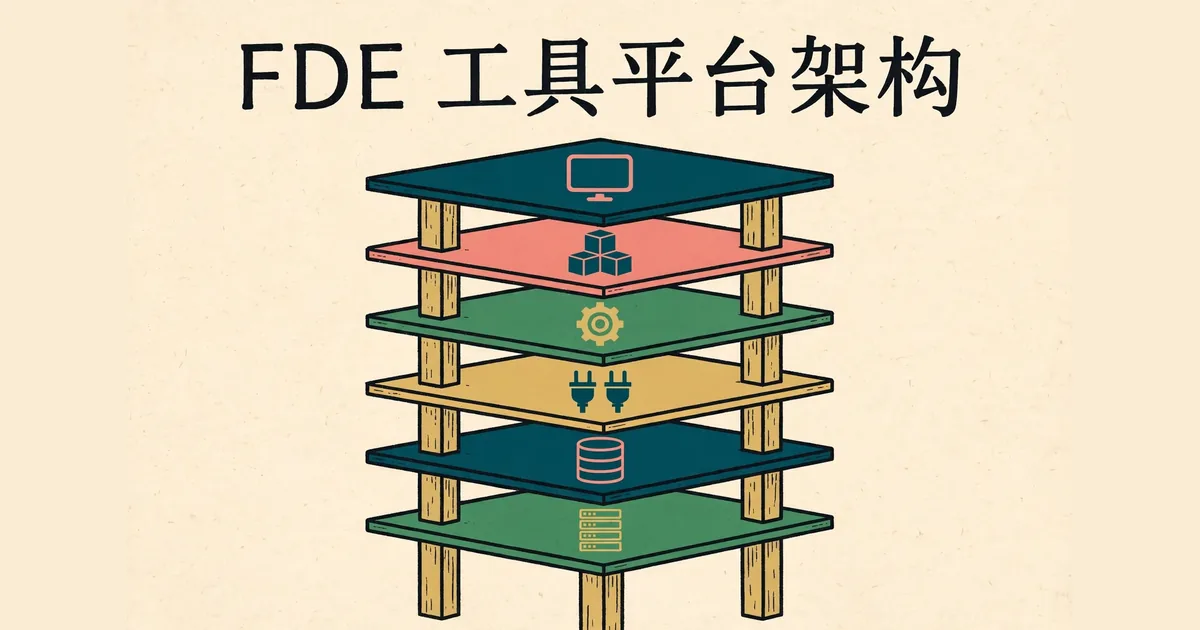
The general architecture of the FDE tool platform divides into six layers, top to bottom: the upper layers face users and scenarios, the lower layers face running and infrastructure. Three further capabilities cut across all layers.
1. Interaction layer (Web / App)
The layer users touch directly, with just two entry points:
- Task operations: submit tasks, view progress, handle the nodes that need human involvement;
- Configuration management: maintain scenario, tool, and runtime-related configuration.
2. Scenario & domain Pack layer
A domain’s way of working is packaged into an assemblable Pack, containing five kinds of content:
- Business objects and scenario configuration;
- Skills / SOPs;
- Domain evaluation cases;
- Business processes and validation rules;
- Tool combinations and output templates.
The Runtime itself hardcodes no business; changing the scenario means changing the Pack.
3. Agent Runtime layer
The layer that executes tasks, in two forms:
- Full version: task decomposition → planning → step-by-step execution → replanning → synthesis → quality check, suited to complex, long-chain research tasks;
- Lightweight version: minimal necessary context → tool-call loop → result check → output, suited to simple, low-latency interactive tasks.
4. Tool & system connection layer
All tool calls converge on one unified execution entry, passing in order: registration → parameter validation → authorization → approval where necessary → audit. A human checkpoint sits next to the entry; high-risk actions stop and wait for human confirmation.
The entry connects outward to four kinds of targets:
- Client APIs / databases;
- MCP services;
- Files / documents / browsers;
- Code and CLIs in an isolated environment.
5. Data, knowledge & memory service layer
Composed of three services:
- Data service: data ingestion, governance, synchronization, versioning;
- Knowledge service: ingestion, RAG parsing, indexing, retrieval, plus Embedding, Rerank, graphs, and LLM wiki;
- Memory service: short-term and long-term memory, supporting write, review, correction, and deletion.
6. Run & infrastructure layer
Responsible for tasks finishing reliably, in three parts:
- Task control and run storage: Task / Run / Thread, Workers, cancel, recovery;
- Run data and artifacts: sessions, Checkpoints, approval records, Artifacts;
- Infrastructure: model gateway, databases, file storage, sandbox, deployment, backup.
7. Three cross-cutting capabilities
Belonging to no single layer, they run through all six:
- Identity & security: who is calling, what they may call, and where the boundaries are;
- Quality & evaluation: whether results meet the bar, and how cases keep verifying that;
- Observability & operations: runs are visible; when something goes wrong it can be located and replayed.
(This article was compiled into text from the text elements of the architecture canvas of the same name.)