Reflowing Project Knowledge: A Method Summary
After a project ends, what is worth keeping, and how to sort it by value into ontologies, processes, rules, and reusable Packs — a human-reviewed method, with the sorting and output records from one real case.
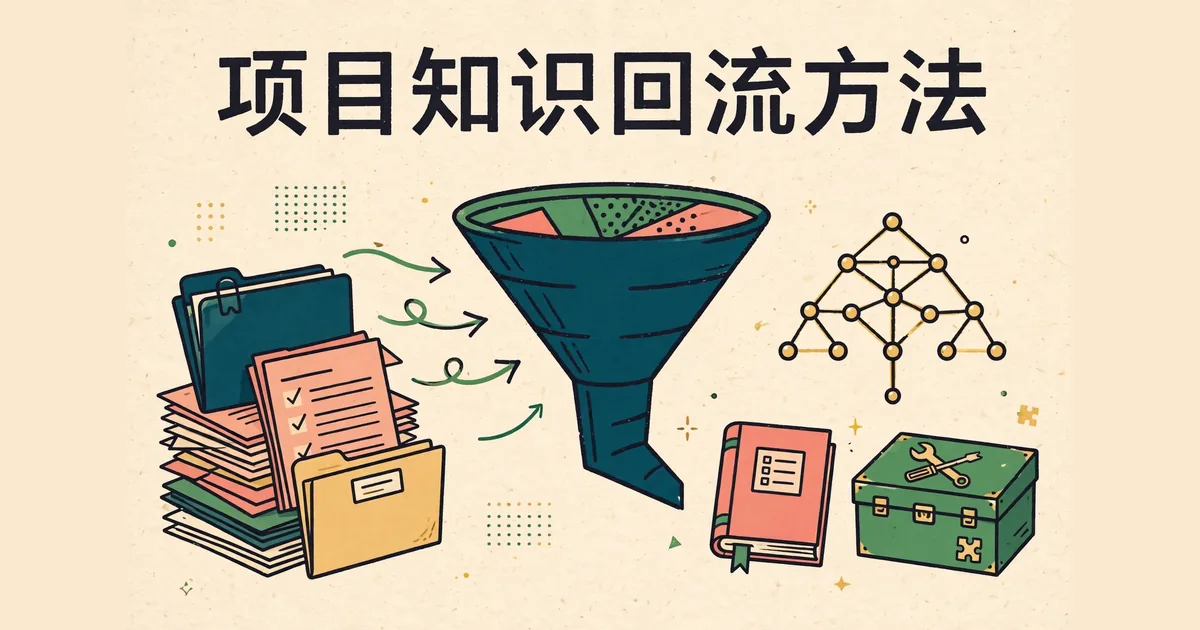
1. What knowledge reflow is for, once a project is done
Knowledge reflow does not mean copying every project file into a knowledge base. It means sorting what a project produced into layers, by how much future reuse value each part has:
Project materials
├── Low-density presentations, background material, cases
│   └── Sanitized, then into the industry document store for RAG retrieval
├── Process agreements, policies, technical specifications
│   └── Extract process models, rule models, and evidence chains
├── Stable business structures of the industry
│   └── Extract an ontology model
├── Project deliverables and client facts
│   └── Kept as project instances; never auto-promoted to industry knowledge
└── Reusable methods and tools
    └── Into the FDE capability catalog or a method Pack
The core principle:
Decide what the future will need first, then decide what to extract from the documents — instead of turning every document into knowledge up front.
2. The steps
1. Inventory the project materials
Build a materials list and record:
- File type;
- Source department;
- What the document is for;
- Authority level;
- Whether it contains sensitive client information;
- Whether duplicate versions exist;
- Whether it has already been parsed or OCR’d.
2. Pin down the future reuse questions
Answer these first:
- What will similar future projects ask?
- Which judgments need rule support?
- Which processes need to be reused?
- Which business objects need a shared way of being expressed?
- What is only good as background reference?
This is the most important step of all.
3. Sort the documents by value
Four classes work well:
| Type | How it is handled |
|---|---|
| Routine presentations, meeting minutes, background material | Sanitized, then into the document store |
| Policies, process agreements, technical specifications | Extract ontology, processes, rules, and evidence |
| Structured lists, matrices, registers | Saved by field mapping |
| Project facts, client views, project deliverables | Kept as project instances; not promoted to general knowledge |
4. Extract source facts and evidence
Do not rush into building the ontology. First record:
- Concepts as stated in the source;
- Roles as stated in the source;
- Actions as stated in the source;
- Conditions as stated in the source;
- Outputs as stated in the source;
- Page, section, or paragraph;
- Document version;
- OCR or human-verification status.
5. Extract processes, rules, and the ontology
For high-value documents, extract in this order:
Source facts
  ↓
Concepts and roles
  ↓
Relations between objects
  ↓
Process nodes and states
  ↓
Rule conditions and actions
  ↓
Evidence registration
  ↓
Ontology model
The ontology mainly answers “what objects exist, and how are they related”; rules mainly answer “under what conditions must what be done”; processes mainly answer “in what order do things happen”.
6. Human review
AI can do these automatically:
- Document classification;
- Candidate concept extraction;
- First drafts of processes and rules;
- Cross-document comparison;
- Duplicate-concept detection;
- Evidence location.
Humans must confirm:
- Whether two concepts really are the same;
- Whether two roles can be merged;
- Whether a rule is a formal policy, a local candidate, or a project-level agreement;
- Whether a numeric threshold is generally applicable;
- Whether a project fact can be promoted to industry knowledge;
- Whether concrete business instances should be generated.
7. Build an ontology registry
Every ontology must state:
- Why it exists;
- What it describes;
- Its source;
- Its authority level;
- Its scope of application;
- Its version;
- Its human-confirmation status;
- Which questions it can answer;
- Where it can be reused;
- Where it must not be used.
8. Package it as a reusable Pack
In the end, a Pack contains at least:
Ontology model
Process model
Rule model
Evidence registration
Reuse boundaries
Typical query questions
Human review records
3. What the current case has actually produced
This case inventoried 47 project documents, initially sorted as:
- 9 rule, process, and specification documents: structured extraction;
- 7 list, matrix, and model documents: structured fields preserved;
- 6 FDE method and solution documents: method candidates extracted;
- 6 report, case, and industry documents: into the RAG / case store;
- 18 interview documents: sanitized, source and metadata kept, with cross-interview synthesis;
- 1 ZIP file: handled as a container, not ingested twice.
What exists so far:
- The four-piece set (ontology, process, rules, evidence) for 3 rule sources;
- Cross-alignment across the 3 rule sources;
- 1 cross-project FDE reflow governance Pack;
- 1 consulting Agent work-domain ontology;
- 1 standalone ontology registry;
- 6 registered ontology entries;
- The consulting Agent ontology contains 17 classes, 19 relations, 10 rules, and 12 competency questions;
- The eight key boundaries H01–H08 have all been confirmed by a human.
The most important outcome of this case is not “how much was extracted”, but that several boundaries are now explicit:
Consulting project ≠ client innovation project
Research claim ≠ innovation outcome
Agent evidence record ≠ client business evidence material
Consulting deliverable ≠ client outcome package
Single-project method ≠ cross-project general method
Client threshold ≠ industry-wide rule
Related outputs:
- 知识回流治理 Pack
- 本体注册库
- 咨询 Agent 本体扩展
- 资料分流结果
4. The honest current state
What is done so far is:
A human-reviewed knowledge-reflow governance prototype.
What is not done yet:
- Automatically recommending applicable ontologies for new projects;
- A graphical ontology browser;
- A formal Protégé/OWL version;
- Automatically generating client business-domain instances;
- Wiring every ontology directly into production retrieval;
- Validating the reuse effect on follow-up projects.