Consulting Agent 2.x: A Human–Agent Research Workbench
From single-question Q&A to a project-level workbench: tasks can be archived, interrupted, and resumed, and evidence only enters the store after review.
2.x changed the unit from “a question” to “a project”. Projects, stages, Work items, question trees, and research rounds all became first-class objects in the system. People start research tasks on top of them and the agent assists with execution; research direction, business framing, whether a piece of evidence is believed, and important decisions all stay with humans. What it solves is not “let the model write one more passage” — it is moving a piece of research all the way from a business question to a reviewable deliverable: question decomposition, source retrieval, evidence formation, human judgment, agent execution, quality checks, and result traceability all happen in a single workflow.
Core capabilities
- A question-driven research workbench: the basic unit is the research question, not a message; the hierarchy is Project → Stage / Work → question tree → research round → Agent / sub-agent execution.
- Evidence-based output: every result is linked to Evidence, Claims, Citations, the source catalog, Research Events, and Artifacts — not a lone piece of text.
- Source processing and quality states: text, PDF, PPTX, and OCR all enter the processing pipeline; sources carry archive / restore states and evidence carries eligibility states — material that hasn’t passed the eligibility judgment never enters the formal evidence set.
- Model, Skill, and MCP management: unified registration, validation, enable/disable, probing, and agent binding, with audit throughout; MCP connects to external services in the agent-client pattern.
- Quality evaluation and run monitoring: a serial real-model evaluation plan, Artifact replay, and evidence / citation gates; failures are filed under categories such as timeout and
scope_blocked, not just reported as “failed”.
The governed runtime
To hold up under long tasks, the runtime manages Task, Run, Thread, Checkpoint, Lease, Approval, and Artifact separately: tasks can queue, pause, wait for a human, and resume after review, and a task that stops halfway can be taken over by another Worker under a lease. One entry in the 2.0 freeze record stuck with me: an offline run stopped in a waiting-for-human state and was later resumed and ran to completion — that’s exactly where you find out whether a long-task system works.
A few designs are worth calling out. Before a tool actually executes, it has to pass eight checks in a row: cancellation check, lease check, timeout check, approval-binding validation, tool-call budget, permission policy, and redaction audit — and only then the actual tool handler. Permissions aren’t a log you append after execution; they’re a row of gates in front of it. Traces are recorded in three separate layers — research-layer events, Runtime tool events, and management audit — because mixing them makes investigations painful. Research results enter the store only after human review, and can be admitted, returned, archived, restored, and revised; even after admission they keep a “research note” (research_note) provenance marker instead of being laundered into independent primary evidence. External search is off by default, and anything found outside goes into a candidate pool first and only counts as formal evidence after quality judgment and human confirmation.
System architecture
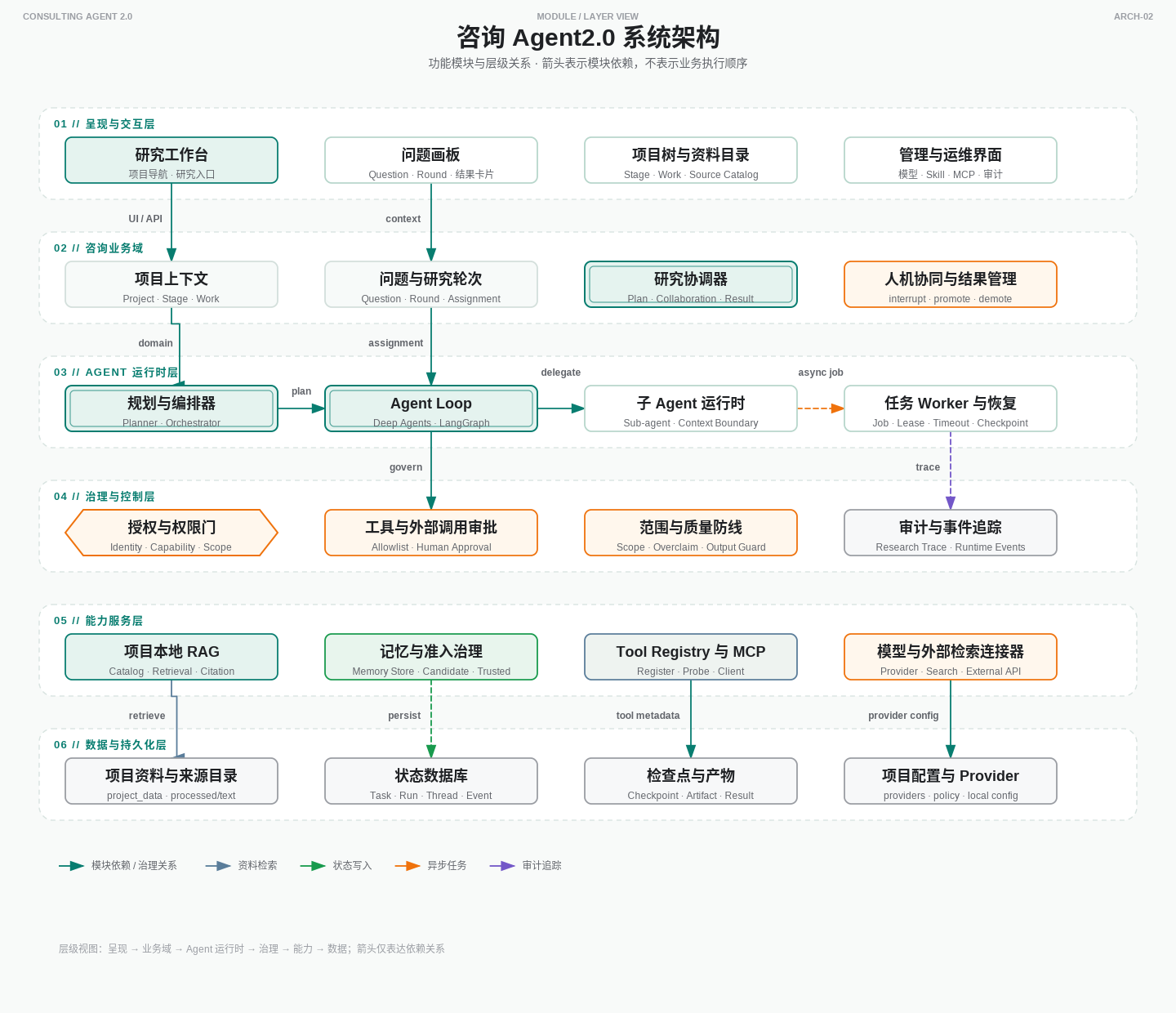
The whole system has five layers:
- Interaction & entry layer: a React interface, including the home page, the research workbench, agent details, reports, catalog, configuration, and monitoring pages.
- Consulting-research domain layer: domain objects such as Project, Work, Question, Assignment, AgentExecution, ResearchEvent, and reports.
- Governed Runtime layer: the Deep Agents / LangGraph agent loop, Control Plane, Tool Gate, Checkpoint, Lease Fence, and Workers.
- Capability & data services layer: project corpus, results corpus, Memory, external retrieval, Tool Registry, and MCP Runtime.
- Persistence & external-boundary layer: project state, tasks, research Jobs, Artifacts, Memory, token accounting, and external evidence are persisted separately, never mixed together.
The main flow runs: establish project context → generate and review a research plan → create research rounds and Assignments → run the Agent Loop inside the governed Runtime → mid-way human clarification, additional material, or tool approvals → form Evidence / Claim / Citation / Artifact → quality checks and human review → deliver, continue researching, or let a human decide whether it enters the project document store. The code repository holds only reproducible code, tests, and general documents; actual project material, runtime data, and model keys never go into Git — a rule this line set down back in 1.0.
Version history and records
2.0 first stood up the workbench and the governed Runtime; 2.1 added research workflows, role teams, and governed sub-agents; 2.2 added dynamic routing between an ontology and RAG — a question is first classified to decide which retrieval path it takes, and evidence is allocated dynamically by tracing back to the source text. At the 2.0 freeze, 431 tests passed; for 2.2, real external vector retrieval was exercised on four business questions, and it’s on record. Same caveat once more: these are records from the time, and full acceptance testing in the target environment was never finished — the README itself states that the real model, external retrieval, MCP connections, and enterprise deployment capability each need separate acceptance testing against the concrete environment.
Diagrams

Updates
- 2.2 freeze: added dynamic routing between the ontology and RAG